
Google Releases Gemini 3.8 Flash, Its Third Flash Model in Six Weeks
Google announced today the release of Gemini 3.8 Flash, its third Flash model in just six weeks, further accelerating its pace of updates in the artificial intelligence space. Described by Google as its best reasoning and coding model yet, Gemini 3.8 Flash comes in two variants: the standard version, designed for agentic tasks and software development, and Gemini 3.8 Flash Cyber, specialized in vulnerability detection and mitigation. Despite the frequency of these releases, Google has not introduced a frontier-level Gemini Pro model since early 2026, suggesting that the promised Gemini 3.5 Pro may be shelved. Google's strategy appears to be focusing on lightweight, fast models rather than larger, more expensive ones. From a technical standpoint, Gemini 3.8 Flash shows marginal improvements over its predecessor, Gemini 3.7 Flash, particularly in coding evaluations where it leads the DeepSWE leaderboard, a measure of a model's ability to solve complex software engineering problems. However, in computer use tasks, as evaluated by OSWorld-2.0, the model still lags behind market leaders like Claude Opus. The Cyber variant, which replaces the 3.5 version, has demonstrated substantial improvement in internal testing, identifying more vulnerabilities and issuing working patches more frequently. The Chrome security team reported a 2.6x increase in patch accuracy, while the Cloud team claimed the model found a critical vulnerability in just two hours. Partners like Wiz and Palo Alto Networks have also endorsed the capabilities of Gemini 3.8 Flash Cyber. For developers and enterprises, Google maintains its strategy of attractive pricing, offering API access to Gemini 3.8 Flash at an introductory rate of $0.75 per million input tokens and $3.75 per million output tokens, with a planned increase at the end of the year. This approach aims to keep customers engaged in a market where competitors like Anthropic and OpenAI have recently reduced their token pricing. The model will be available through Google AI Studio and Vertex AI, allowing users to access both free and advanced features via Pro or Ultra subscriptions in the Gemini app. Strategically, Google's approach reflects a shift toward rapid, iterative releases of smaller models, prioritizing speed and efficiency over the development of larger, more complex models. This approach could be key to driving enterprise adoption of AI solutions, as it allows businesses to access advanced capabilities without incurring prohibitive costs. However, the constant rollout of new models also presents challenges in terms of stability and consistency in enterprise integrations. In the long run, this strategy could solidify Google's position as an agile and accessible provider in the competitive landscape of generative AI.

World's Largest Dark Matter Detector Catches a Strange Particle
The world's largest dark matter detector, known as XENONnT, has recorded an unusual particle signal that doesn't match existing particle physics models. Located at Italy's Gran Sasso National Laboratory, the experiment uses more than 8 tons of liquid xenon to capture the faint interactions between dark matter and ordinary matter. The detected signal could potentially be linked to axions, neutrinos, or even an entirely new form of physics that scientists have yet to identify. Researchers emphasize that while the finding is exciting, more data is needed to confirm the exact origin of the particle. The team continues to analyze results and collect new information to rule out possible noise sources or interference. If confirmed, this discovery could transform our understanding of the universe and open new research avenues in the search for elusive dark matter. This breakthrough represents a significant milestone in experimental physics, demonstrating the capability of current detectors to identify extremely weak signals. The international scientific community will closely follow XENONnT's next steps, which could provide crucial clues about the composition of the 85% of matter that makes up the cosmos but remains invisible to our instruments.

Paint.NET 5.2 Alpha Introduces Linux Support After Two Decades of Windows Exclusivity
The renowned Windows image and photo editor Paint.NET has officially released its 5.2 Alpha build (9739), introducing experimental native-compatible Linux support for the first time in the software’s two-decade history. The development has triggered significant excitement across the developer and creative communities, where Paint.NET has long been regarded as one of the most missed desktop applications by users transitioning from Windows to Linux workstations. From an architectural standpoint, porting Paint.NET to Linux posed exceptional engineering hurdles due to the application's deep historical reliance on Windows-specific graphics subsystems, notably Direct2D, DirectWrite, and proprietary .NET desktop APIs. Lead developer Rick Brewster achieved the milestone through an ambitious clean-room reimplementation and abstraction of Direct2D components tailored for Wine and cross-platform display servers, a multi-month effort significantly accelerated by leveraging advanced AI code generation to tackle low-level graphic translation layers. Within the broader desktop software landscape, Paint.NET occupies a uniquely sweet spot between the barebones functionality of standard MS Paint and the intimidating complexity of tools like GIMP. For years, open-source Linux clones such as Pinta struggled to match Paint.NET's stability, plugin maturity, and responsive hardware-accelerated canvas. With official Linux builds entering testing, Linux creators and power users gain access to a premier multi-layer editor without needing full Windows virtual machines or dual-boot configurations. Looking ahead, the arrival of Paint.NET on Linux underscores a broader modernization trend in legacy desktop software powered by modern .NET runtimes and AI-assisted cross-platform porting. While the current 5.2 release remains an alpha targeted at early adopters and bug reporting across various Linux distributions, ongoing development focuses on polishing GPU acceleration and plugin architecture, cementing one of the year’s most anticipated cross-platform milestones.

Google Avoids Breakup of Ad Tech Business in Major Ruling
Google has successfully avoided a forced breakup of its ad tech business, marking a significant legal victory for the tech giant amid increasing regulatory scrutiny. The ruling, issued by a federal court, preserves Google's current structure in digital advertising operations, allowing the company to maintain its dominant position in the online ad market. This outcome reinforces Google's control over a critical segment of the internet economy. The decision comes after prolonged regulatory battles concerning Google's market power and its effects on competition. Critics and regulators have long argued that Google's vertical integration across the advertising supply chain harms competitors and stifles innovation. However, the court determined that proposed remedies were disproportionate and unsupported by sufficient evidence, ultimately siding with Google's defense. This ruling carries far-reaching implications for the future of tech regulation in the U.S. and globally. As authorities worldwide intensify their scrutiny of major tech companies, the favorable outcome for Google may set a precedent affecting similar cases involving other dominant players in their respective markets.

Palo Alto Networks Acquires Console for $500M to Power Autonomous Cortex AI Agents
Palo Alto Networks has acquired Console, a two-year-old startup that leverages artificial intelligence agents to automate routine enterprise IT helpdesk operations, in a $500 million cash-and-stock transaction. The acquisition marks one of the most significant strategic moves this year bridging proactive cybersecurity and autonomous IT operations. Founded in 2024 by Andrei Serban following the acquisition of his prior startup Fuzzbuzz by Rippling, Console developed an agentic workflow platform capable of resolving repetitive technical requests without direct human intervention. Its autonomous agents routinely handle credentials resets, software provisioning across tools like Figma and Miro, and end-to-end troubleshooting for modern engineering teams, counting high-growth enterprises such as Ramp, Flock Safety, and Scale AI among its core customer base. From a venture capital and valuation standpoint, Console had secured $29 million across two funding rounds led by Thrive Capital and DST Global, having reached a $157 million valuation according to PitchBook. The transaction provides an exceptional and rapid return for early backers including SV Angel and Abstract Ventures, as well as Palo Alto Networks CEO Nikesh Arora, who participated as an early angel investor. In the enterprise automation landscape, Console competed directly with Serval, a ServiceNow challenger recently valued at $1 billion following a Sequoia-led Series B. Palo Alto Networks plans to deeply integrate Console’s autonomous capabilities into its Cortex security platform. As Palo Alto’s seventh acquisition in 2026—following high-profile deals including observability leader Chronosphere ($3.35 billion) and cyber firm Koi ($400 million)—the deal equips Cortex with natural language execution capabilities, providing security and IT teams with the operational autonomy needed to resolve enterprise-wide alerts in real time.

“Exit the Cave”: reconnecting with the real world
“Exit the Cave” is an essay about the tension between living inside digital systems and staying connected to the real world. It uses a personal reflection to question how much attention, judgment, and experience we delegate to platforms and devices. Rather than a technology news item, it is a cultural analysis of technology’s human impact: what digital convenience gives us and what we may lose when we stop looking beyond it.

How sources behind AI recommendations are manufactured
An independent analysis of 380 software categories examines how AI-integrated search systems build recommendations. It sent 760 queries—one per category to Perplexity/sonar and one to Perplexity/sonar-pro through OpenRouter—and collected 7,534 citations. 59.8% of cited domains were outside the 100,000 most visited sites, while 23.4% did not appear in Tranco’s top million. The central finding is not that a few famous sites control answers: the ten most-cited sources represented only 17.3% of citations. The striking pattern lies at the periphery, where 751 of 2,055 cited domains were unranked and had more recent Wayback captures. Some appeared designed to be consumed by retrieval systems, with automated pages and descriptions explicitly oriented toward model grounding. The report identifies three apparently related domains that published 215,128 automated “best software” pages, and highlights guideflow.com, whose blog was cited 194 times across 96 categories despite not being a directory or operating in those markets. The authors compare sitemaps, templates, DNS, registration dates, and archived pages, while noting that shared infrastructure is circumstantial evidence, not proof of common ownership. The broader lesson is that AI answers can rely on recent, high-volume content designed for machines without making its authority obvious. The study measured only Perplexity—Google was excluded—so its findings should not automatically be generalized to every search engine or model.

Meta Unveils Muse Spark 1.3: New Open-Source Language Model
Meta has announced the release of Muse Spark 1.3, a new iteration of its open-source language model designed for advanced natural language generation and understanding tasks. This version introduces significant improvements in computational efficiency and output quality, positioning itself as a competitive alternative in the accessible language model ecosystem. Muse Spark 1.3 stands out for its ability to process extended contexts and generate coherent responses in multiple languages, including enhanced support for low-resource languages. The model's architecture has been optimized to reduce carbon footprint during training and inference, aligning with Meta's AI sustainability commitments. The model is available under an open-source license that permits commercial use and modification, fostering community innovation. Researchers and developers can access the model weights and detailed documentation through Meta AI's official repository, driving the development of custom applications and academic research.

FCC plans robocall scorecard to grade phone companies on spam call blocking
The Federal Communications Commission today said it will create a robocall mitigation scorecard to rate phone companies on how effectively they block illegal spam calls. The scorecards could include call-blocking statistics along with data on customer complaints and enforcement actions. The FCC said scorecards could grade providers on a number scale, with letter grades, or by classifying providers as low risk, medium risk, or high risk. "The Scorecard will empower consumers and encourage provide
Massive Driver's License Leak on Dark Web: 153 Million IDs Exposed
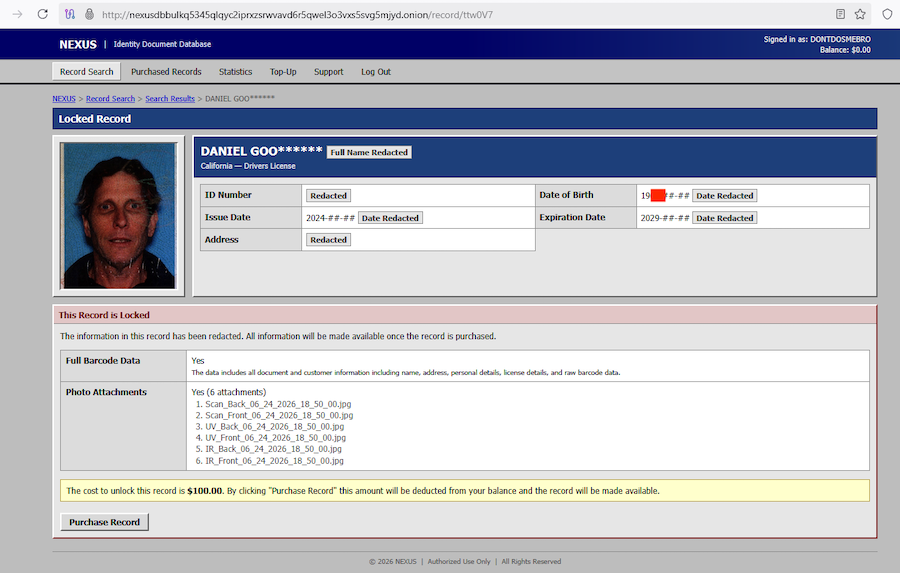
An unprecedented data breach has exposed over 153 million driver’s licenses on a new cybercrime platform called Nexus, uncovered by security researcher Brian Krebs. The platform, which operated for hours before disappearing following the exposé, included high-resolution scans of documents belonging to public figures, journalists, and FBI agents. The central victim in the case, a tech journalist, discovered that his license had been scanned by a car rental company and, within hours, appeared for sale on the dark web. According to Krebs, the breach appears linked to IDScan.net, a New Orleans-based ID scanning service that collaborates with companies like Hertz and Planet13. The platform offered not only visible-light images but also infrared and ultraviolet spectrum scans, enabling the creation of nearly undetectable counterfeit IDs. Technically, Nexus operates as a marketplace for stolen identities, integrated with third-party services that process physical documents in real time. The system exploits vulnerabilities in ID scanning APIs to access sensitive data, including metadata and specialized formats. The files include multiple image layers: front, back, infrared, and ultraviolet, suggesting attackers have access to specialized hardware or internal systems of partner companies. The attack architecture indicates advanced automation, with new documents appearing on the platform within minutes or hours of being scanned. This points to near real-time access to databases or cloud services used by businesses that entrust their scans to IDScan.net. From a business and financial ecosystem perspective, Nexus represents a new paradigm in the cybercrime marketplace: specialized platforms offering access to complete identities with advanced verification tools. While no direct investors or funding details have been disclosed, the business model resembles dark web subscription services where users pay for access to updated databases. Competition in this space includes platforms like Genesis Market and XSS, but Nexus stands out for its focus on physical identity documents with cloning capabilities. The rapid emergence and disappearance of the platform suggests a highly coordinated operation, possibly backed by criminal access groups with significant technical resources. Strategically, this incident highlights the fragility of the digital identity supply chain across industries such as travel, retail, and financial services. Companies relying on third parties for document scanning must reassess their security and audit protocols. The U.S. government, including the FBI, is already investigating the case, which may lead to new regulations on handling identification data. In the long term, increased adoption of end-to-end encryption and decentralized identity verification is expected. The cybersecurity market will likely see accelerated growth in identity protection solutions, especially in sectors handling large volumes of sensitive documents.

TechCrunch Disrupt 2026’s new Real World AI Stage features Nvidia, robots, and extinct animals
TechCrunch Disrupt 2026 will once again place AI at the heart of its program, but with a new twist: a dedicated Real World AI Stage. The event, taking place October 13‑15 at San Francisco’s Moscone West, expands its AI offerings by introducing this fresh stage, which explores the intersection of digital and physical realms. It will highlight how autonomous hardware is moving beyond self‑driving cars to occupy public spaces, battlefields, homes, and even potentially aid extinct species in re‑entering Earth. The lineup features speakers from leading companies such as Shield AI, Colossal Biosciences, FieldAI, Foxglove, and Nvidia, among others still to be announced. The first session tackles the data gap that hampers general‑purpose robotic intelligence. While large language models had the internet and self‑driving cars have millions of hours of road data, robots lack that foundational data. This shortfall is the primary reason most experts believe broad robotic AI is still years away, despite breakthroughs elsewhere in AI. A new wave of startups is racing to close this gap by building data pipelines, simulation environments, and foundation models that could spark a capability explosion similar to that seen with LLMs. Les Karpas, Head of Physical AI at Nvidia, will lead a discussion on what the ChatGPT moment for physical AI truly requires and how close we really are. The second session focuses on safety and readiness when AI enters the physical world. A mistake can ground an aircraft, crash a vehicle, or jeopardize a mission. Leaders building autonomous vehicles, defense technologies, and industrial systems will address one of the toughest questions every hard‑tech founder faces: how to know when a system is safe to deploy. The panel will explore how founders can cultivate a safety culture, test and validate AI, navigate regulatory hurdles, and build trust in high‑stakes environments. Nate Michael, CTO of Shield AI, will participate in this discussion. The third session, a fireside chat, features Ben Lamm, CEO of Colossal Biosciences, a company known for turning de‑extinction from science fiction into a billion‑dollar business. Lamm will discuss the technologies used to revive extinct species, the role AI plays in modern biology, and the growing debate over whether engineering nature is a conservation breakthrough or a distraction from protecting existing wildlife. His talk highlights the ethical, technical, and commercial dimensions of attempting to bring back lost species. The fourth session brings together leaders in edge AI from defense, space, and industrial sectors. Dr. Ali Agha, CEO and founder of FieldAI; Michelle Lee, CEO and founder of Medra; and Aidan Madigan‑Curtis, partner at Eclipse Ventures, will share how they have made AI work where latency matters, connectivity is limited, and failure is not an option. Expect practical lessons on architectural principles, design decisions, and trade‑offs that enable AI‑centric systems to function in real‑world conditions. These insights have direct implications for companies deploying AI in challenging environments. Finally, the fifth session addresses the critical transition from prototype to production and scaling. Founders who have successfully crossed this gap in space hardware, humanoid robotics, and autonomous systems will share what they got wrong, what they would have done earlier, and what the prototype‑to‑production journey looks like when supply chains and manufacturing realities replace lab conditions. John Mackey will contribute his perspective on navigating this complex path. The panel underscores the practical challenges and strategies needed to move from a working prototype to a scalable, profitable business, offering actionable takeaways for deep‑tech startups.